
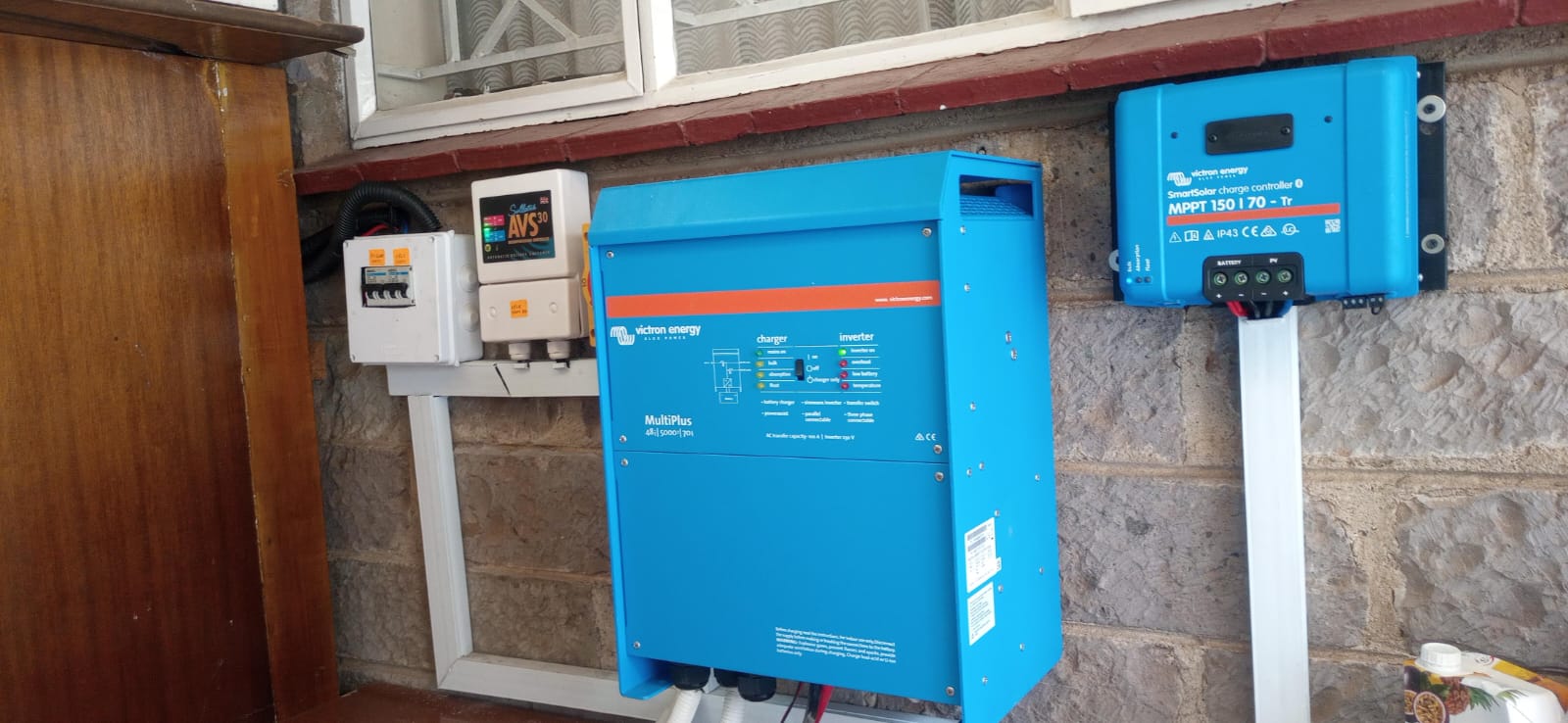
When designing a solar power system for your home or business, one small component plays a massive role in protecting your batteries and maximizing energy harvest: the solar charge controller. If you are shopping around for an MPPT charge controller, the Kenya market options can feel overwhelming.
The choice ultimately boils down to two distinct technologies: Pulse Width Modulation (PWM) and Maximum Power Point Tracking (MPPT). Selecting the wrong one can cause you to lose up to 30% of your solar panels’ potential energy.
Understanding the Core Technologies
1. PWM Charge Controllers (The Standard Switch)
A PWM controller acts as a direct electronic switch between your solar panels and the battery bank. When the battery voltage reaches its charging limit, the controller slowly pulses the connection to maintain a stable charge.
- The Catch: It forces your solar panels to operate at the exact voltage of the battery. If you have a 24V solar panel connected to a 12V battery bank, the excess voltage is effectively wasted.
2. MPPT Charge Controllers (The Smart Transformer)
An MPPT controller functions like a smart, highly efficient DC-to-DC transformer. It continually tracks the optimal voltage and current of the solar array known as the Maximum Power Point.
- The Benefit: If your panels generate excess voltage, the MPPT controller drops the voltage to match the battery profile but simultaneously steps up the current. This means you harvest nearly 100% of the available power from your roof.
Real Kenyan Climatic Data – How Do They Actually Perform?
Many off-grid system buyers assume that a premium MPPT controller is always the superior option. However, local field research conducted right here in Nairobi reveals a critical nuance.
According to an experimental study by Kenyatta University researchers, environmental temperatures drastically dictate the efficiency margin between these two technologies
| Metric / Environment | Under Moderate Temperatures (Below 50°C Cell Temp) | Under Extreme Tropical Heat (Above 52°C Cell Temp) |
| MPPT Additional Energy Gain | 24% to 29% more energy harvested over PWM | Drops to 0.2% (Advantage disappears) |
| Ideal Local Geographical Focus | Nairobi, Central Highlands, Kiambu, Kericho | Northern Kenya (Turkana, Garissa), Coastal Belt, Magadi |
The underlying physics reveals that as solar panel cells get intensely hot, their operational voltage naturally plummets (Adamu et al., 2024). When the panel voltage drops close to the battery voltage, the MPPT controller has no extra voltage left to convert into current, making its performance closely match that of a standard, lower-cost PWM unit (Adamu et al., 2024).
MPPT vs PWM: Direct Comparison Matrix
| Feature | PWM Charge Controller | MPPT Charge Controller |
| Conversion Efficiency | Low to Moderate (Drops excess panel voltage) | High (93% to 98% efficiency via smart transformation) |
| System Scalability | Low (Panels and battery bank must match voltages) | High (Allows high-voltage arrays to charge low-voltage batteries) |
| Best Used For | Small setups (e.g., Solar Home Systems under 200W) | Large installations (Residential and commercial setups over 300W) |
| Relative Cost in Kenya | Budget-friendly (Lower upfront capital) | Higher initial investment (Compensated by high energy yields) |
The Verdict: Which One Should You Buy?
To get the absolute best return on your solar investment, look closely at your system architecture and local climate conditions:
- Buy a PWM Controller if: You are setting up a small, low-voltage solar home system (such as running a few DC lights and a TV), using low-wattage matching panels, or working in a consistently hot region with tight budget constraints where high panel voltages aren’t used (Adamu et al., 2024).
- Buy an MPPT Controller if: You are investing in a large-scale residential grid-tied or hybrid system, using high-efficiency panels over 300W, or living in regions with fluctuating weather patterns (like Nairobi or the Rift Valley) where harvesting every drop of morning and evening light is vital to beat high KPLC token costs.