
Managing an educational institution in Kenya has become a balancing act between maintaining academic standards and controlling skyrocketing operational overheads. With grid electricity tariffs from Kenya Power (KPLC) fluctuating between KSh 18 and KSh 28 per kWh due to fuel cost adjustments and forex levies, energy bills are eating deeply into school development funds.
Fortunately, the operational landscape is shifting. The government’s recent rollout of the National Basic Institutions’ Solarisation Program has signaled a mandatory transition toward green energy. For primary schools, secondary boarding institutions, and universities alike, deploying solar for schools in Kenya is no longer just an environmental choice; it is a financial necessity.
The Economic Case: Slashing Institutional Overhead
The primary driver for implementing solar infrastructure across Kenyan campuses is the instant reduction in recurring monthly utility costs. Most educational facilities experience their peak energy consumption during daytime hours when computer labs, administrative blocks, sci-tech equipment, and water pumping systems are fully active. This usage profile perfectly aligns with peak solar radiation hours.
| Energy Parameter | KPLC Grid Power | Kamatye Institutional Solar |
| Average Cost per kWh | KSh 18 – KSh 28 | KSh 8 – KSh 14 (Amortized LCOE) |
| Daytime Blackout Protection | None (Requires diesel backup) | 100% Seamless Auto-Switchover |
| Monthly Budget Predictability | Variable (Subject to fuel levies) | Fixed & Protected for 25+ Years |
By moving daytime operational loads to a custom-engineered solar array, a typical mid-sized boarding school can redirect hundreds of thousands of shillings every term away from KPLC tokens and straight back into student learning resources, infrastructure expansion, or teacher development.
Powering the Competency-Based Curriculum (CBC)
The transition to the Competency Based Curriculum (CBC) and the Ministry of Education’s Digital Literacy Programme (DLP) have made stable electricity a core pedagogical requirement. Schools cannot train students on digital devices, smart projectors, or modern laboratory equipment if the power drops mid-lesson.
Uptime Matters for Security: For boarding institutions, power continuity is a critical safety pillar. A hybrid solar installation ensures that campus perimeters, dining halls, and dormitories remain brightly lit throughout the night, completely eliminating the vulnerability of sudden KPLC blackouts.
Funding Pathways and EPRA Compliance
One of the biggest historical friction points for institutional boards was the upfront capital investment. However, specialized asset financing frameworks have completely lowered this barrier. Through institutional partnerships with major commercial lenders like Kenya Commercial Bank (KCB), schools can now access specialized green energy facilities where the installation costs are offset directly by the monthly savings generated by the system itself.
From a regulatory standpoint, the compliance pipeline is highly efficient. Under current Energy and Petroleum Regulatory Authority (EPRA) guidelines, captive solar generation systems under 1 Megawatt (MW) installed on-site for own-use are exempt from complex commercial generation licensing. However, to maintain safety and preserve structural equipment warranties, the system layout must be designed and commissioned by an EPRA-certified technical partner.
Transition Your Institution with Kamatye
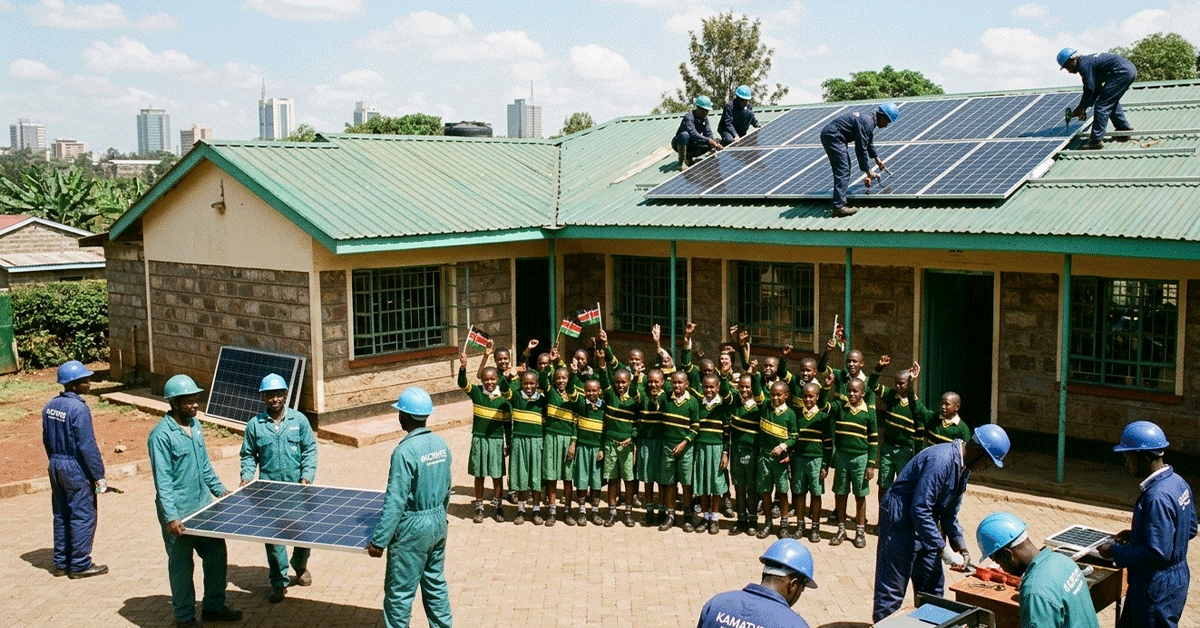
As an established engineering and solar contractor, Kamatye handles the complete lifecycle of institutional energy transitions. We conduct pre-site structural roof assessments, execute precise load-profile calculations, install premium KEBS-compliant solar plates, and manage all necessary KPLC net-metering approvals. Let us protect your school’s operating budget from unpredictable power costs.

Exploring KCB Financing Options for Kenyan Schools
The green transition for educational institutions in Kenya has received immense structural backing. The Ministry of Education rolled out a national directive under the National Basic Institutions’ Solarisation Program, positioning Kenya Commercial Bank (KCB) as the central financial engine to fund public and private schools transitioning away from high grid costs and biomass.
The financial framework is specifically structured around a school’s seasonal cash flow, making it an operationally seamless “pay-as-you-save” model.
The KCB Clean Energy Financial Framework
KCB offers specialized facilities split between structured public school programs and direct clean energy unsecured loans for private schools. The core target is to ensure that your termly repayments never choke your daily school operations.
| Financial Parameter | Public Schools (MoE Framework) | Private Institutions Facility |
| Negotiated Interest Rate | 9.75% per annum (Fixed) | Risk-based lending rate |
| Loan Tenor (Duration) | Up to 5 Years (60 Months) | Up to 5 Years (60 Months) |
| Financing Limits | Determined by approved BoQ | KSh 100,000 to KSh 10 Million+ |
| Repayment Alignment | Termly intervals (capped at 40% of termly fees) | Termly installments from fee collections |
| Collateral Structure | Unsecured / Deed of Fee Assignment | Unsecured / Deed of Fee Assignment |
The Repayment Architecture
The fundamental rule of this facility is Accrued Savings Deflection. Repayments are drawn heavily from the structural savings generated by dropping your KPLC bills or eliminating firewood/diesel costs. For public institutions, funds can also be legally channeled from the school’s Maintenance and Improvement Fund (M&IF) with Ministry approval.
Strict Requirements & Documentation Checklist
To unlock KCB green lending, school Boards of Management (BOM) must compile a meticulous technical and financial dossier. KCB requires complete visibility to ensure the project is economically viable.
1. Technical & Structural Data (To be compiled by your installer)
- Energy Load Profile: Complete inventory of your school’s electrical equipment (lighting, computer labs, kitchen energy, water pumps) alongside the last 3 to 12 months of KPLC electricity bills.
- Structural Roof Integrity: Detailed survey highlighting roof surface area, structural age, and material profiling to verify it can safely support solar arrays.
- Priced Bill of Quantities (BoQ): A fully audited technical layout design and price breakdown signed off by an EPRA-licensed technician and structural engineer.
2. Administrative & Financial Documents
- BOM Resolution: Formal, signed Board of Management meeting minutes confirming a unanimous resolution to borrow for the solarization project.
- Ministry Authorization: Copy of the school’s valid registration certificate from the Ministry of Education (plus explicit MoE regional director approval for public framework loans).
- Financial Accountability: Audited accounts for the last 3 consecutive years (mandatory for loans exceeding KSh 5 Million) or certified 12-month internal income/expense statements.
- Banking History: A minimum of 6 months of active banking relationship with KCB (or 12 months of statements if the school uses multiple banking entities).
The Compliance Red Line: KCB strictly prohibits upfront cash advances directly to schools. Under the framework guidelines, the bank retains full control of the central program performance dashboard and disburses funds directly to framework-approved solar companies only after certified milestone sign-offs by an EPRA technician and a Ministry of Public Works consultant.