
Investing in solar power in Kenya requires understanding how different photovoltaic technologies react to our unique equatorial climate. Between the intense heat of Garissa, the cool humidity of Limuru, and the dust of the Rift Valley, a panel that excels in Europe might underperform on your roof.
When evaluating the primary types of solar panels available in the local market, your choice fundamentally impacts your system’s long-term return on investment (ROI). Monocrystalline, Polycrystalline, and Bifacial panels each process Kenya’s high solar irradiance differently.
Understanding the Three Core Types of Solar Panels

1. Monocrystalline Panels (The High-Efficiency Standard)
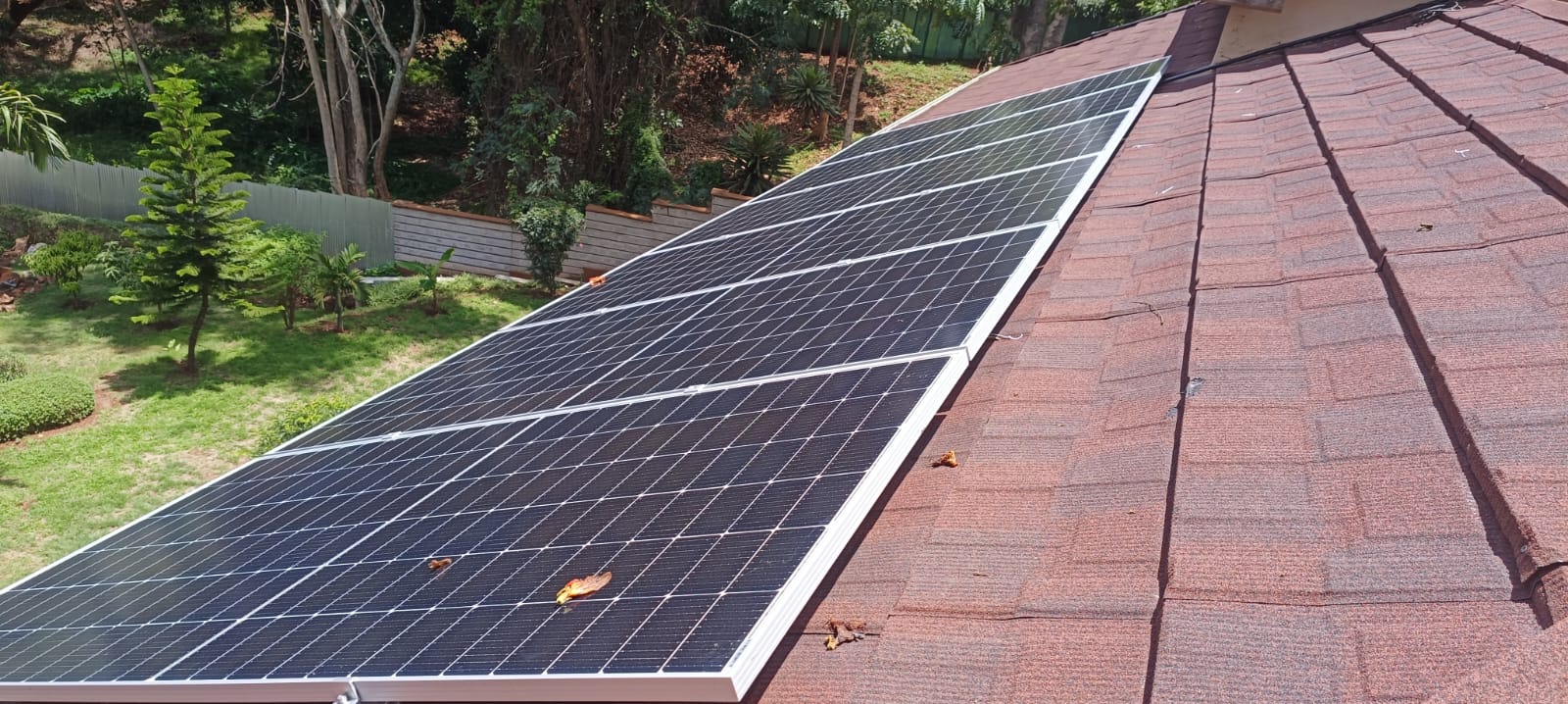
Monocrystalline panels are sliced from a single, pure silicon crystal structure. You can easily recognize them by their dark, uniform black appearance and rounded edges.
- The Kenya Climate Advantage: They offer the highest efficiency rates (typically 20% to 22%). Crucially for warm regions like Mombasa or Kisumu, modern premium mono panels feature a superior temperature coefficient (the rate at which a panel loses efficiency as it gets hotter than 25°C). They retain more of their power output in peak afternoon heat than older technologies.
2. Polycrystalline Panels (The Budget-Conscious Alternative)
Polycrystalline panels are manufactured by melting multiple silicon fragments together. They have a speckled blue look and square corners.
- The Kenya Climate Advantage: They are less expensive upfront, making them highly popular for small-scale domestic installations and rural off-grid setups. However, they struggle in extreme heat. Their higher temperature coefficient means their performance drops noticeably during scorching afternoons in northern or coastal Kenya.
3. Bifacial Panels (The Next-Gen Yield Maximizers)
Bifacial panels feature dual-sided glass that absorbs sunlight from both the front and the back.
- The Kenya Climate Advantage: These panels capitalize on the albedo effect (light reflected off the ground or surrounding surfaces). In sandy, light-colored soil environments or when mounted on light-colored commercial rooftops in Nairobi, the rear side catches scattered light. This boosts total energy generation by 10% to 30% over standard monofacial panels without taking up extra roof space.
Kenya Climate Performance Matrix
| Feature | Monocrystalline | Polycrystalline | Bifacial |
| Average Efficiency | 20% – 22% | 15% – 17% | 20% – 25%+ (Combined) |
| Performance in Extreme Heat | Excellent | Moderate to Poor | Excellent |
| Best Local Applications | Urban residential roofs, limited space setups | Budget rural homes, solar water pumping | Commercial flat roofs, ground-mount farms |
| Relative Upfront Cost | Mid-High | Low | High |
Which Type Fits Your Kenyan Property Best?
Choosing between these types of solar panels comes down to your spatial limitations and localized weather patterns:
The Space vs. Budget Rule: If your roof space in Nairobi is small, Monocrystalline is the standard choice. You will generate more kilowatt-hours (kWh) per square meter, making the absolute most of your available area.
If you are setting up an agricultural solar water pumping system where ground space is plentiful and upfront budgets are tight, a larger array of Polycrystalline panels can still get the job done effectively.
For commercial enterprises, flat-roof warehouses, or ground-mounted arrays in sandy, arid regions, Bifacial panels offer unparalleled output. When paired with high-albedo ground surfaces like gravel or white reflective roof coatings, they actively produce power earlier in the morning and later into the evening than single-sided alternatives.
1. Installation and transportation
First of all, bifacial solar panels due to both sides of the absorption and conversion of solar energy materials make its weight is much higher than monocrystalline solar panels, according to relevant data show that the same size, the weight of bifacial solar panels is usually higher than the weight of monocrystalline solar panels about 5% to 20%, such as a 400watt monocrystalline solar panels weighs about 18kg, while the same size of the weight of the bifacial solar panels is about 20.25kg. For example, a 400watt monocrystalline solar panel weighs about 18kg, while a bifacial solar panel of the same size weighs about 20.25kg.
It is for this reason that the installation and transportation of bifacial solar panels take more time, and if you hire workers to transport and install the panels, you will need to pay more for transportation and installation, which is something you need to consider before you buy.
As the back of the double-sided solar panel also needs to absorb solar irradiance, but the ability of the ground to reflect the sunlight is poor, so in order to improve the efficiency of the back of the power generation, you need to buy reflective devices, this device can reflect more sunlight for the back of the absorption and conversion, although the installation of reflective devices will increase the installation cost, but the later earnings will be greatly increased.
2. Thermal performance
Bifacial solar panels do not have a back panel with superior heat dissipation performance like monocrystalline solar panels, bifacial solar panels are glass panels on both sides, which makes the heat dissipation performance of bifacial solar panels worse than monocrystalline solar panels, and when it is in operation, bifacial solar panels are absorbing the sunlight on both sides, compared to monocrystalline solar panels, the heat will be a lot of heat build-up in bifacial solar panels, which may affect its service life. This may affect its service life.
3. Post-maintenance
Solar panels require regular cleaning of the glass panel to ensure that the solar panel can work properly. Bifacial solar panels need to clean the glass panels on both sides, which takes more time compared to monocrystalline solar panels.
Moreover, due to the unique design of bifacial solar panels, compared to mono solar panels, more frequent inspections are required for bifacial solar panels in order to keep both sides in the best working condition, which further increases the maintenance cost of bifacial solar panels.
4. Cost recovery
Although the cost of bifacial solar panels is higher than that of monocrystalline solar panels, the benefits are much higher than that of monocrystalline solar panels, so in terms of cost recovery, bifacial solar panels require less time than monocrystalline solar panels.
According to relevant data, the normal family use of standard solar panels, bifacial solar panels to build up the solar system requires about 7 years to recover costs, while monocrystalline solar panels to build up the system requires about 8 years to recover costs.
5. Space utilization
In order for reflective devices to work properly, reduce the shadow on the back of the double-sided solar panels to generate electricity. Therefore, compared to monocrystalline solar panels, double-sided solar panels need to be spaced more, which makes the installation of double-sided solar panels on the space requirements greater than monocrystalline solar panels, and the space utilization is lower.
Summary
Bifacial solar panels and monocrystalline solar panels are photovoltaic power generation equipment is to promote the development of green energy. Through an in-depth understanding of the advantages and disadvantages of the two kinds of solar panels, you can pick the solar panels more suitable for your own needs, which is conducive to the solar power equipment serving you better.