
To choose a solar inverter in Kenya, work through five steps: pick the type (hybrid is best for most homes), size it to the total load you’ll run at once plus surge and headroom, match it to your battery voltage, check the key specs (pure sine wave, surge rating, MPPT, warranty), then choose a brand for your budget. A typical Kenyan home is powered by a 3–5 kVA hybrid inverter.
Get a free inverter sizing & quote →
The inverter is the brain of your solar system — it decides how much power you can run at once, whether you keep power during a KPLC blackout, and whether your appliances are protected. Get it right and the system quietly does its job for a decade; get it wrong and you’ll either trip the inverter every evening or pay for capacity you never use. This guide takes you through exactly how to choose, including a worked sizing example you can follow with your own appliances.
If you just want the product overview, prices and what we stock, see our main page on solar inverters in Kenya. This guide is the deeper “how to decide” companion.
Step 1: Choose the right type of inverter
There are three types, and the choice comes down to one question: do you want bill savings, blackout backup, or full independence from the grid?
| Type | Backup in a blackout? | Uses a battery? | Best for |
|---|---|---|---|
| Hybrid | Yes | Yes | Most Kenyan homes & SMEs — savings and backup |
| Grid-tie | No (shuts off) | No | Stable-supply sites wanting bill savings only |
| Off-grid | Yes | Yes (essential) | Remote sites with no/poor grid |
For most homes and small businesses in Nairobi and the surrounding counties, a hybrid inverter is the practical pick; it cuts your bill by day, runs on battery in the evening, and keeps essentials on during outages. If you want the full reasoning, see Off-Grid vs Grid-Tie vs Hybrid Solar: Which Is Right for You?
Step 2: Size the inverter correctly (with a worked example)
This is where most buyers go wrong. Inverters are rated in kVA or kW, and you size them to the total load you intend to run at the same time — not your total number of appliances. There are three things to account for: running power, surge, and headroom.
Add up your running power
List the appliances you’d realistically run together and add up their wattage. For example, a typical home in the evening:
| Appliance | Running power (approx.) |
|---|---|
| LED lights (×10) | ~100 W |
| TV + decoder | ~120 W |
| Fridge (running) | ~150 W |
| Wi-Fi router | ~20 W |
| Phone/laptop charging | ~100 W |
| Water pump (running) | ~750 W |
| Total running load | ~1,240 W |
Wattages are illustrative; check the rating label on your own appliances, as they vary widely.
Account for surge (startup) power
Motors in fridges, pumps and compressors briefly draw two to three times their running power when they switch on. So, although the pump above runs at ~750 W, it may surge to ~1,500–2,250 W for a second or two. Your inverter’s surge rating must comfortably cover the largest motor starting up while everything else is already running.
Add headroom, then pick the rating
Add roughly 20–25% headroom to your running total so the inverter isn’t permanently maxed out (which shortens its life). For the example above: ~1,240 W × 1.25 ≈ 1,550 W of continuous load, plus enough surge capacity for the pump.
A note on kVA vs kW (so you read specs correctly)
Inverters are often advertised in kVA (apparent power), but the useful figure is kW (real power). They’re related by the power factor: kW = kVA × power factor. Many older inverters use a power factor of about 0.8 (so a 5 kVA inverter delivers roughly 4 kW), while many modern inverters are unity (power factor 1.0, so kVA = kW). Always check the spec sheet rather than assuming.
| Your continuous load | Sensible inverter size | Typical home |
|---|---|---|
| Up to ~1 kW | ~1.5–2 kVA | Bedsitter/essentials backup |
| ~1.5 kW (our example) | ~3 kVA | 2–4 bedroom home |
| ~2.5–4 kW | ~5 kVA | Larger home with a pump & more appliances |
| ~5 kW+ | 8–10 kVA+ | Large home / small business |
So our example home lands on a ~3 kVA hybrid inverter: it covers ~1.5 kW continuous with headroom, and its surge rating handles the pump starting. Sizing is easy to get slightly wrong, which is why we size it precisely from your real appliance list — send us your appliances for a free sizing.
Step 3: Match the inverter to your battery
The inverter and battery must speak the same language — chiefly the same system voltage (commonly 12V, 24V, or 48V). Bigger systems generally run at 48V because it’s more efficient at higher loads. The inverter also needs to be compatible with your battery chemistry (lithium vs lead-acid), since charging profiles differ. If you’re buying both together, this is straightforward; if you’re adding to an existing battery, check compatibility first.
For how to choose the battery itself, see our guide to solar batteries in Kenya and Lithium vs Lead-Acid Solar Batteries in Kenya.
Step 4: Check the specs that actually matter
- Pure sine wave output — protects sensitive electronics (fridges, computers, medical devices). Avoid “modified sine wave” for a whole-home inverter.
- Surge/peak power rating — must cover your biggest motor starting up (see Step 2).
- Built-in MPPT charge controller — most hybrid inverters include one; MPPT harvests more from your panels than older PWM. (See our charge controllers page.)
- Efficiency rating — higher means less energy wasted as heat; look for ~90%+.
- Battery compatibility — confirm it supports your battery chemistry and voltage.
- Warranty & local support — a longer warranty signals confidence; local support means faster help if something fails.
- Monitoring — app/Wi-Fi monitoring lets you see performance and spot issues early.
Step 5: Choose a brand for your budget
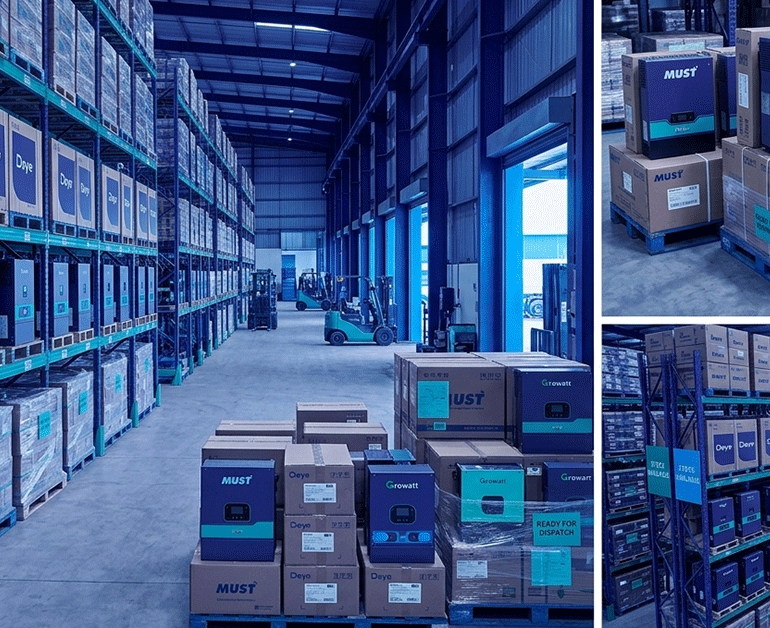
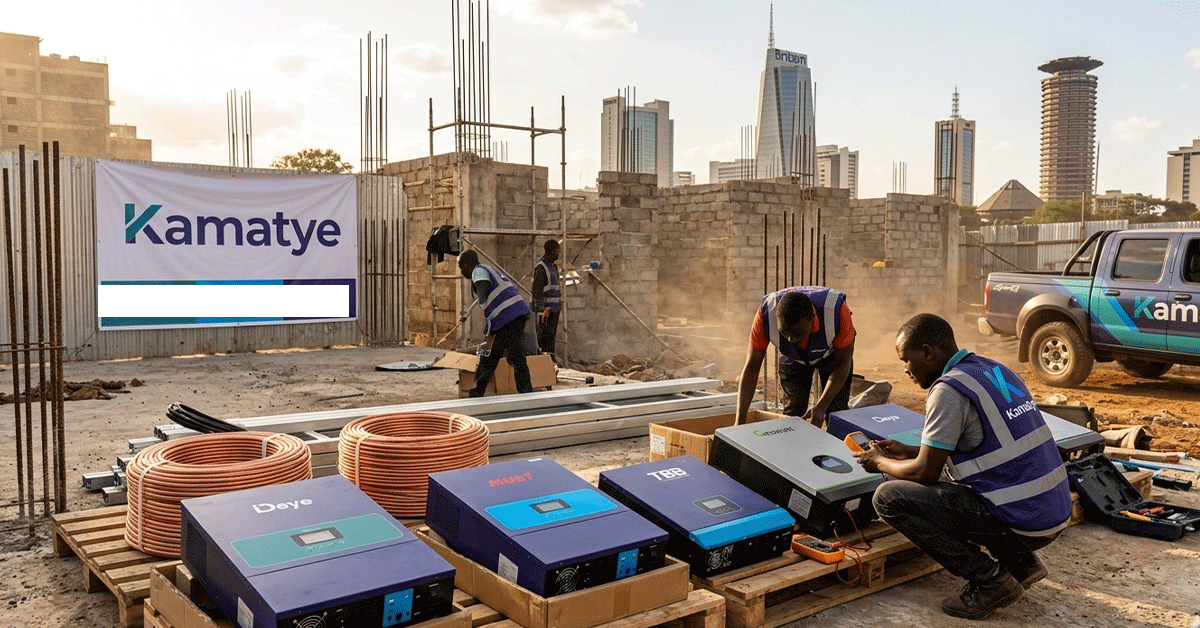
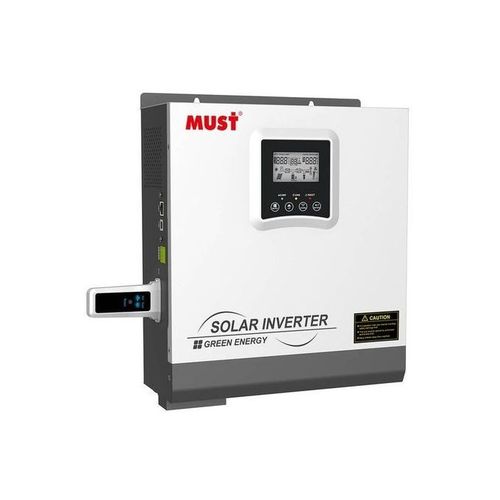
Once you know the type, size, and specs you need, the brand decision is about budget and track record. The brands commonly stocked and trusted in Kenya span budget to premium, for example, Must (budget), Growatt (reliable mid-range), Deye (strong value-to-performance), and Victron/TBB or Huawei at the premium/commercial end. Indicative pricing runs from about KSh 35,000 for small units to KSh 400,000+ for large hybrids (2026, verify current).
For a side-by-side, see Best Solar Inverter Brands in Kenya Compared and Solar Inverter Prices in Kenya (2026, KES)
Common inverter-buying mistakes to avoid
- Buying on price alone. An undersized cheap inverter trips under load and fails early — a false economy.
- Forgetting surge power. A unit that handles your running load can still fail to start a pump or fridge if its surge rating is too low.
- Oversizing “to be safe.” A much-too-big inverter wastes money and can run inefficiently at low loads.
- Ignoring battery voltage compatibility. The inverter and battery must match (12/24/48V) and suit the battery chemistry.
- Choosing a modified sine wave for a whole-home system risks damaging sensitive electronics.
- Skipping the warranty/support question. A cheap inverter with no local support is expensive when it fails.
Quick buyer’s checklist
- Decide type: hybrid (most homes), grid-tie, or off-grid.
- Add up the load you’ll run at once; add surge and ~20–25% headroom.
- Pick the kVA/kW rating that covers that comfortably.
- Match system voltage (12/24/48V) and battery chemistry.
- Confirm: pure sine wave, surge rating, MPPT, efficiency, warranty, support.
- Choose a brand that fits your budget and is supported locally.
- Have it installed and commissioned by a qualified technician.
Want us to do steps 2–7 for you? Request a free sizing & quote → or call 0722 841 601 / 0702 068 376.
Frequently Asked Questions When Choosing Which Solar Inverter to Buy in Kenya
What size inverter do I need for a typical home in Kenya?
Most 2–4 bedroom homes land on a 3–5 kVA hybrid inverter, sized to the load run at once plus surge and ~20–25% headroom. Add up your simultaneous appliances first; a home running lights, TV, fridge, Wi-Fi and a water pump typically needs around 3 kVA.
What’s the difference between kVA and kW on an inverter?
kVA is apparent power; kW is the real power you can use. They’re linked by power factor: kW = kVA × power factor. Some inverters use ~0.8 (so 5 kVA ≈ 4 kW), while many modern units are unity (1.0, so kVA = kW). Check the spec sheet.
Why does surge power matter?
Motors in fridges and pumps draw two to three times their running power for a moment at startup. Your inverter’s surge rating must cover the biggest motor starting while other appliances are already running, or it will trip.
Hybrid or grid-tie, which should I buy?
For most Kenyan homes, hybrid, because it provides backup during KPLC outages as well as bill savings. Grid-tie is cheaper but switches off in a blackout, so it suits sites with stable supply that only want to cut bills.
Does the inverter need to match my battery?
Yes. The inverter and battery must share the same system voltage (commonly 12V, 24V or 48V) and the inverter must support your battery chemistry (lithium or lead-acid). Confirm compatibility before buying, especially when adding to an existing battery.
How much does a solar inverter cost in Kenya?
Indicatively (2026, verify current), from about KSh 35,000 for small units to KSh 400,000+ for large hybrids, depending on size, type and brand. See our solar inverters page for current ranges.
Related reading
- Solar Inverters in Kenya — product overview, prices and what we stock (pillar page).
- Solar Batteries in Kenya — choosing the battery your inverter pairs with.
- Solar Installation Services — full system design, supply and installation.
- Best Solar Inverter Brands in Kenya Compared
- Solar Inverter Prices in Kenya (2026, KES)