
Most Kenyan homes need about 6 to 12 solar panels (of 400–550W). The exact number depends on your daily electricity use and your location’s sun hours. The simple method: take your daily use in kWh, divide by your peak sun hours (about 5 in Nairobi), add ~20% for losses, then divide by your panel’s wattage. A typical 3-bedroom home lands on roughly 8 panels.
“How many panels do I need?” is the question that decides the size and cost of your whole solar system. Guess too low, and you won’t cover your usage; too high, and you pay for power you can’t use. The good news: you can get a solid estimate yourself in three steps using your KPLC bill. This guide shows you exactly how, with worked examples for small, typical, and large homes.
For panel types, brands, and prices, see solar panels in Kenya. This is the sizing companion.
Step 1: Find your daily electricity use (kWh)
You need your daily consumption in kilowatt-hours (kWh, also called “units” on your KPLC bill). Two ways to get it:
- From your KPLC bill (easiest): take your monthly units and divide by 30. Example: 300 units ÷ 30 = 10 kWh/day.
- From your appliances: multiply each appliance’s wattage by the hours you use it, divide by 1,000, and add them up. Then add about 10% for standby and small devices you missed.
Using your KPLC bill is the most reliable, because it reflects how you actually live. If your bill varies by season, use a higher (busier) month so you don’t undersize.
Step 2: Know your peak sun hours
“Peak sun hours” (PSH) is the number of hours per day when sunlight is strong enough to generate at full rated power. It’s not the same as daylight hours. Kenya is well-placed: most areas get 4 to 6 peak sun hours a day. Nairobi averages about 5; coastal and northern regions can reach 5.5–6. We’ll use 5 as a sensible planning figure — confirm your local figure for accuracy.
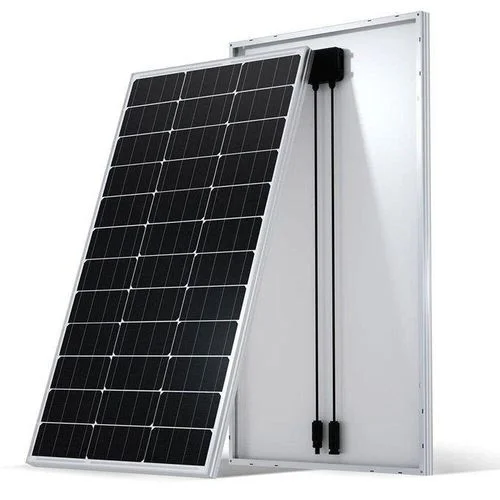
Step 3: Do the calculation
The formula has two parts. First, the solar array size you need; then the number of panels.
Array size (kW) = daily use (kWh) ÷ (peak sun hours × 0.8)
The 0.8 accounts for real-world losses of about 20% (heat, wiring, inverter, and battery inefficiency, dust). Then:
Number of panels = array size (W) ÷ panel wattage (W)
Worked example: a typical home
- Daily use: 10 kWh (from a ~300-unit monthly bill).
- Array size = 10 ÷ (5 × 0.8) = 10 ÷ 4 = 2.5 kW (2,500 W).
- At 450W panels: 2,500 ÷ 450 ≈ 6 panels. At 550W panels: 2,500 ÷ 550 ≈ 5 panels.
So a typical 10 kWh/day home needs roughly 5–6 high-wattage panels to cover its usage. Many installers add a panel or two of margin for cloudy days, battery-charging losses, and future growth — which is how a 3-bedroom home often lands at 8 or so panels.
Quick reference: panels by home size
Using the method above (5 peak sun hours, ~20% losses), here’s a rough guide. Treat as a starting point — your real number comes from your actual usage and a site assessment.
| Daily use | Monthly bill (approx.) | Array size | Panels (450–550W) | Typical home |
|---|---|---|---|---|
| ~6 kWh | ~180 units | ~1.5 kW | ~3–4 panels | Small home/essentials |
| ~10 kWh | ~300 units | ~2.5 kW | ~5–6 panels | Typical 2–3 bedroom |
| ~15 kWh | ~450 units | ~3.75 kW | ~7–9 panels | Larger 3–4 bedroom |
| ~20 kWh | ~600 units | ~5 kW | ~9–12 panels | Large home |
Indicative, using 5 peak sun hours and a ~0.8 performance ratio; panel counts rounded. Higher-wattage panels (550W) mean fewer panels for the same output. Real requirements vary with location, roof, appliances and whether you add a battery — confirm with a load assessment.
What changes the number of panels
- Panel wattage. Higher-wattage panels (e.g. 550W) need fewer units than 400W panels for the same output — useful on small roofs. (See Monocrystalline vs Polycrystalline Solar Panels )
- Your location’s sun hours. More peak sun hours = fewer panels.
- Whether you have a battery. If you store energy for night use, you need enough daytime generation to both run the house and charge the battery, which can mean a few more panels.
- Roof space and orientation. Panels perform best facing true north in Kenya, tilted appropriately; shading reduces output.
- How much of your bill do you want to cover? Covering 100% needs more panels than offsetting part of your usage.
- Future plans. Adding appliances (or an EV) later means sizing with headroom now.
Will the panels fit on my roof?
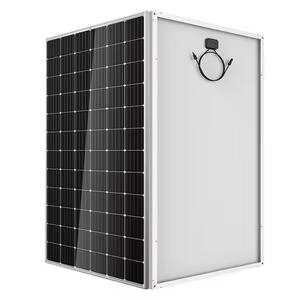
A modern 450–550W panel is roughly 2 square metres. So a typical 6–8 panel home system needs about 12–16 m² of well-oriented, unshaded roof. Most Kenyan homes have enough roof for a residential system; tight or heavily shaded roofs are where higher-wattage panels (fewer needed) and careful layout matter. We assess your roof as part of the design.
Get an exact panel count for your home
The method above gives a solid estimate. For an exact figure — accounting for your appliances, roof, location and whether you want backup — we provide a free load assessment and a fully sized proposal.
Request your free sizing & quote → or call 0722 841 601 / 0702 068 376.
Frequently asked questions
How many solar panels does a typical Kenyan home need?
Most homes need about 6 to 12 panels of 400–550W. A typical 3-bedroom home using 200–350 units a month usually needs around 8–12 × 400W panels (or fewer if using higher-wattage 550W panels). The exact number depends on your usage and location.
How do I calculate how many solar panels I need?
Take your daily use in kWh, divide by your peak sun hours (about 5 in Nairobi), and divide by ~0.8 to allow for losses — that gives your array size in kW. Then divide the array size in watts by your panel wattage. Example: 10 kWh ÷ (5 × 0.8) = 2.5 kW ≈ 5–6 × 500W panels.
How many panels for 1,000 kWh per month?
That’s about 33 kWh/day. Array size = 33 ÷ (5 × 0.8) ≈ 8.25 kW, which is roughly 15–18 panels at 450–550W. This is a large home or small commercial system; a proper load assessment is essential at this size.
What are peak sun hours in Kenya?
Most of Kenya gets 4–6 peak sun hours per day. Nairobi averages about 5, while coastal and northern regions can reach 5.5–6. Peak sun hours measure when sunlight is strong enough for full output, not total daylight.
Does having a battery change how many panels I need?
It can. If you store energy for night use, your panels must generate enough during the day to both run your home and charge the battery (allowing for charging losses), which sometimes means adding a panel or two.
Do higher-wattage panels mean fewer panels?
Yes. A 550W panel produces more than a 400W panel, so you need fewer of them for the same output — helpful when roof space is limited.